Discover a professional 3D printing powder supplier
PRODUCT PARAMETERS
Description
Overview of Hot ing 3d Printing Filament Extruder machine Plastic filament machine
3D printing, also known as additive manufacturing, is a transformative technology that allows the creation of three-dimensional objects by depositing materials layer by layer based on digital designs. This process opens up a new world of possibilities in product design, customization, and production, revolutionizing various industries including healthcare, aerospace, automotive, consumer goods, and more.
Customization & Personalization: One of the key advantages of 3D printing is its ability to create highly customized products tailored to individual needs or preferences, from prosthetics to fashion accessories.
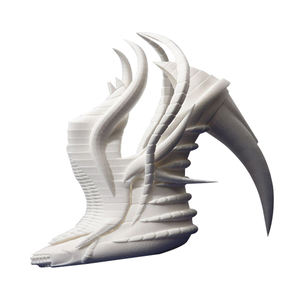
Complex Geometry: 3D printing excels at producing intricate shapes and geometries that would be extremely challenging or impossible to manufacture using conventional methods, such as internal lattice structures or organic forms.
Rapid Prototyping: It significantly speeds up the product development cycle by enabling designers and engineers to quickly produce physical prototypes for testing and refinement.
On-Demand Manufacturing: The technology supports small-batch or even one-off production runs economically, reducing the need for large inventories and allowing for just-in-time manufacturing.
Material Diversity: A wide range of materials can be used in 3D printing, including plastics, metals, ceramics, composites, and even biomaterials, each offering unique properties for specific applications.
Reduced Waste: As compared to subtractive manufacturing techniques, 3D printing only adds material where needed, leading to less waste and a more sustainable manufacturing process.
Features of Hot ing 3d Printing Filament Extruder machine Plastic filament machine
Design Flexibility: The technology enables the realization of complex designs without the constraints of traditional manufacturing tools and molds.
Functional Integration: Parts can be designed with integrated features such as channels, cavities, or interlocking components, which can enhance functionality or simplify assembly.
Lightweight Structures: Advanced 3D printing techniques allow for the creation of lightweight yet strong structures through optimized designs and the use of lattice structures or composite materials.
Improved Performance: By precisely controlling material composition and structure, 3D printed parts can exhibit enhanced mechanical, thermal, or electrical properties.
Cost-Efficiency for Complexity: While 3D printing may not always compete with mass-production methods for simple parts, it becomes increasingly cost-effective as the complexity of the part increases.
Innovative Applications: From medical implants that match a patient’s anatomy perfectly to aerospace components that reduce weight and increase efficiency, 3D printing pushes the boundaries of what’s possible in product design and engineering.

(Hot ing 3d Printing Filament Extruder machine Plastic filament machine)
Specification of Hot ing 3d Printing Filament Extruder machine Plastic filament machine
This machine turns plastic pellets into filament for 3D printers. It heats the plastic pellets. Then it pushes the melted plastic through a small hole. This makes a thin plastic line. That line is the filament. You need good filament for good 3D prints. This machine helps you make your own. You can control the temperature very well. Different plastics need different heat. You set the exact temperature you need. The machine uses a screw inside a barrel. The screw spins and pushes the pellets forward. The barrel gets hot. The heat melts the pellets. The screw keeps pushing the melted plastic. The melted plastic goes through a nozzle. The nozzle hole decides the filament thickness. You can change nozzles. This lets you make different sizes of filament. Common sizes are 1.75mm and 2.85mm. You can use many types of plastic pellets. PLA pellets are popular. ABS pellets work too. PETG pellets are another option. You can also try special pellets. You adjust the speed of the screw. This controls how fast the filament comes out. You want a steady speed. This keeps the filament thickness even. Cooling is important after the nozzle. The hot filament needs to cool down fast. The machine has fans. These fans blow cool air on the filament. This makes the filament solid and strong. The machine has rollers. These rollers pull the filament. They keep the tension right. This helps get a smooth filament surface. The machine is built tough. It handles the heat and pressure. Making your own filament saves money. You can also use recycled plastic pellets. This is good for the environment. You get the exact filament you want.

(Hot ing 3d Printing Filament Extruder machine Plastic filament machine)
Applications of Hot ing 3d Printing Filament Extruder machine Plastic filament machine
A hot end filament extruder machine melts plastic pellets. It pushes the melted plastic through a nozzle. This nozzle shapes the plastic into thin filament strands. The filament cools down quickly. Then it winds onto spools. These spools feed into 3D printers. Many different plastics work. PLA, ABS, PETG are common choices. Nylon, TPU, and even recycled plastics work too. The extruder heats the plastic carefully. This step is important. It ensures the melted plastic flows smoothly. The machine pulls the filament as it forms. This pulling gives the filament its exact thickness. Consistent thickness is crucial for good 3D printing.
People use these machines for recycling. They shred old plastic prints or waste. They feed these shreds into the extruder. The machine melts the shreds. Then it makes new filament. This saves money. It also cuts down on plastic waste. Businesses find this useful. So do hobbyists. Creating custom filament is another key use. You mix different plastic pellets. You add special colors or additives. You experiment. This produces unique filament types. You get custom colors. You get special material properties. Maybe you want wood-like filament. Maybe you want glow-in-the-dark filament. The extruder makes it possible.
Producing industrial-grade filament is another application. Some factories need large amounts of specific plastic. Buying it pre-made costs a lot. Using an extruder lets them make it themselves. They control the quality. They control the formula. They save costs over time. Prototyping new material blends is important too. Material scientists use extruders. They test new plastic mixtures. They see how the filament performs. They refine their recipes before large-scale production. The extruder is a flexible tool. It turns raw plastic into useful filament. It supports recycling efforts. It enables creative material development. It provides cost-effective solutions for businesses.
Company Profile
3D Printing Passion is a trusted global chemical material supplier & manufacturer with over 12-year-experience in providing super high-quality 3D printing powder and relative products.
The company has a professional technical department and Quality Supervision Department, a well-equipped laboratory, and equipped with advanced testing equipment and after-sales customer service center.
If you are looking for high-quality 3D printing materials and relative products, please feel free to contact us or click on the needed products to send an inquiry.
Payment Methods
L/C, T/T, Western Union, Paypal, Credit Card etc.
Shipment
It could be shipped by sea, by air, or by reveal ASAP as soon as repayment receipt.
5 FAQs of Hot ing 3d Printing Filament Extruder machine Plastic filament machine
What materials can I use? You feed plastic pellets. You use common plastics like PLA, ABS, PETG. You can also use recycled plastics. The machine melts them down. Then it makes new filament.
What temperature should I set? The right temperature depends on the plastic. PLA needs a lower heat. ABS requires a higher heat. You find the best settings in the manual. You might adjust them slightly. You adjust based on how the melted plastic looks.
Why is my filament inconsistent? Check your pellet size first. Big pellets cause problems. Make sure you feed pellets evenly. Look at the melting temperature. Wrong temperature causes bad thickness. Check the pulling speed. Wrong speed messes up the thickness.
The filament jams. What do I do? This often happens from dirty pellets. Clean your pellets well before using them. Check for blockages in the feeder tube. See if the melting zone is clogged. Turn off the machine. Let it cool down. Then clear the blockage carefully.
How much filament can I make per hour? The speed depends on your machine model. It depends on the plastic type. Thicker filament takes longer. The machine manual gives estimated rates. Expect around 2 to 5 kilograms per hour. This is typical for many models.

(Hot ing 3d Printing Filament Extruder machine Plastic filament machine)